9.2 -
1
2
3
4
5
6
7
8
9
10
11
12
13
14
15
16
17
18
19
20
21
22
23
24
25
26
27
28
Parts catalogue
Caution
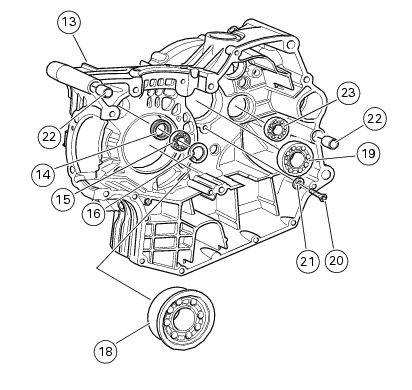
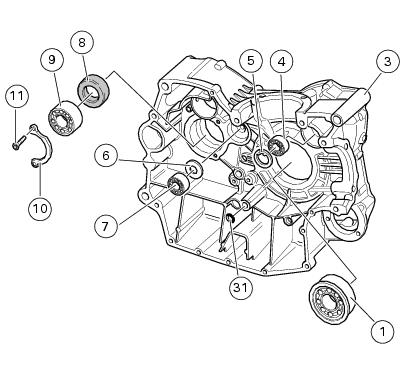
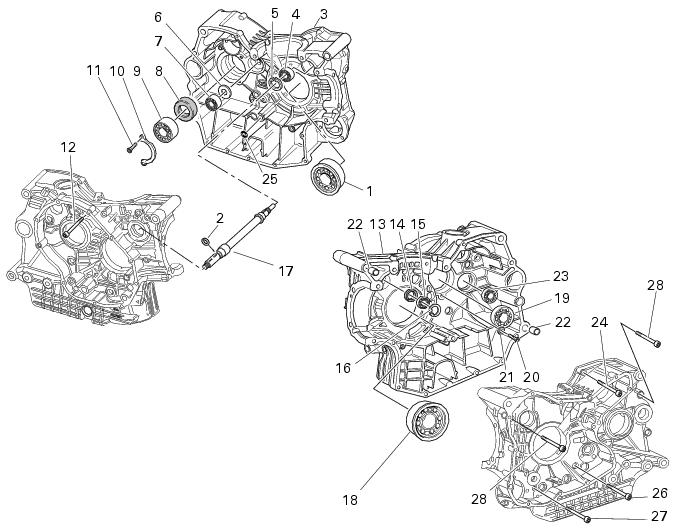
Bold reference numbers in this section identify parts shown in this exploded view diagram. These parts do not appear in the figures near the text.
Opening the casings
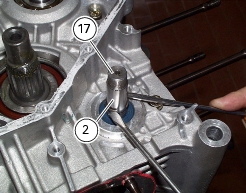
Using two screwdrivers, remove the snap ring (2) from the timing layshaft on the clutch-side casing.
Note
When removing the circlip, take care not to score the shaft surface.
 
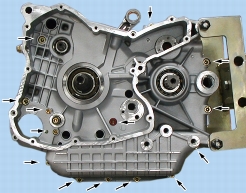
Undo the casing jointing screws on the generator side.
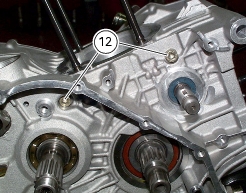
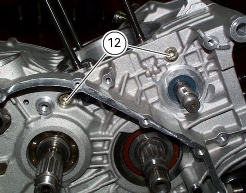
Unscrew the two screws (12) on the clutch side casing at the vertical cylinder location.
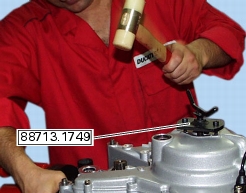
Use generator cover or a service cover with puller part no. 88713.1749 fitted to it. Secure cover to casing with some of the original screws and begin separation by turning the central pin of the tool.
Tap on gearbox secondary shaft with a plastic hammer to separate casings.
Note
Do not damage or lose the shims on the shafts and on the selector drum.
Remove gearbox shafts and gearbox selector drum from the casing (Sect. N 7.2, Gearbox assembly: gearbox shafts).
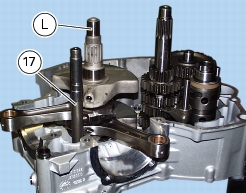
Slide out the crankshaft (L) using a plastic hammer. Do not damage or lose the shims.
Remove timing layshaft (17) and take O-ring (25) in the oil duct between casings.
Overhauling the casings
Carefully inspect the crankcases.
 
Place the casings on a reference surface and check that the mating surfaces of the casings are perfectly flat.
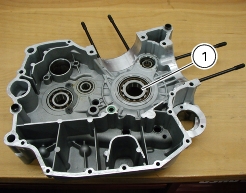
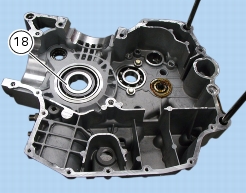
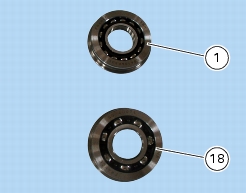
Check bearings (1) and (18) for wear. Note that the main bearings must always be changed in pairs (see procedure in “Main bearings”, next paragraph).
Note
Replace all crankcase bearings when overhauling the engine.
 
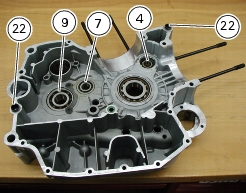
When replacing gearbox shafts bearings (19) and (9), secure them in place in the casings using the spacers (2) and the stop plate (10).
Change the oil seal (8) placed outside the bearing (9) every time casings are overhauled.
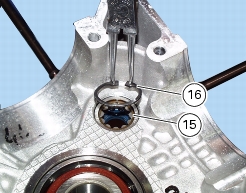
Replace the bearings (7) and (23) at the ends of the gearbox shafts and the bearings (4) and (15) supporting the timing lay shaft.
Do not damage the shim (6) between the bearing (7) at gearbox primary shaft end and the casing on chain side.
Replace the seal ring (14) outside the needle roller bearing (15) at each overhauling.
Check that the oilways are not clogged or obstructed.
Check the condition of locating bushes (22). If apparently distorted or loose in their seats, change them using proper tools.
When the locating bushes (22) are hard to remove from casing, use a left-hand tap to force bushes out.
Caution
Never re-use any bushes (22) that have been removed with a tap.
 
Main bearings
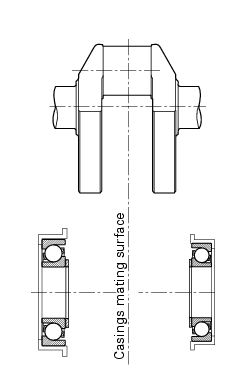
The main bearings have offset inner races so that the balls can transmit the loads from one groove to the other along straight lines at a particular angle to bearing axis. The angle-contact ball bearings are designed for bearing combined loading (radial-axial loads).
They may bear axial loading in one direction only. Because of radial loading, the bearing produces an axial force that must be combined with an opposite force and it is thus usually fitted in opposition to another.
To change the bearings, proceed as follows:
-
-
-
-
Caution
On badly worn engines, bearing bushes may have developed clearance in the casing - normally, bushes are interference-fit in the casing.
 
Check that casing to bushing interference, with bearings (1) and (18) installed, is not below 0.03 mm; if not so, change the casings.
Note
See chapter at the end of this section for proper main bearing shimming.
 
Reassembling the casings
Carefully inspect the casings. They should be in perfect conditions and clean. Mating surfaces must be perfectly flat and free from burrs.
Reassembling the clutch-side casing
Check that the following parts are in place inside casing:
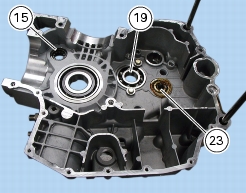
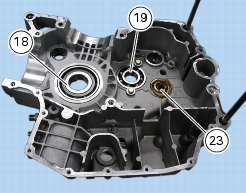
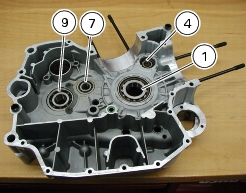
Secondary shaft end bearing (23).
The bearing (19), supporting the primary shaft, secured through screws (20) and retaining spacers (21).
The main bearing (18) with bush (17).
The roller bearing (15) with snap ring (16) at timing lay shaft.
Reassembling the generator-side casing
Check that the following parts are in place inside casing:
The double ball ring bearing (9) for the selector fork shaft, with plate (10) and retaining screws (11).
The gearbox primary shaft bearing (7) with inner spacer (6).
Main bearing (1).
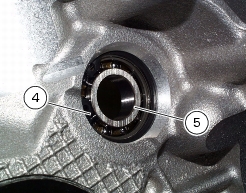
The bearing (4) with circlip (5) at the timing layshaft.
Note
Except for the main bearings, all other bearings do not have a mounting direction.
Shimming the shafts
Before closing the casings, calculate the shims required to take up crankshaft and gearbox shafts end float.
To determine correct shimming, proceed as follows.
Shimming the crankshaft
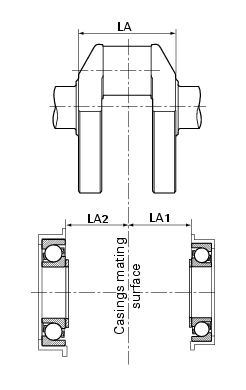
After fitting the new main bearings, proceed as follows to determine the total shimming "SA".
Measure "LA" between the crankshaft surfaces that contact the bearings.
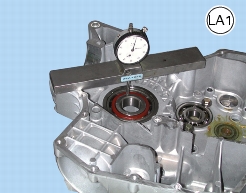
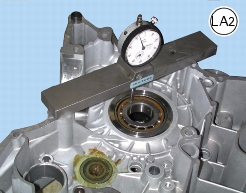
Measure the depths "LA1" and "LA2" corresponding to the distance between the mating surfaces of the two casings and the contact surfaces of the inner races of the bearings;
Add a pre-load of 0.30 mm. This will compensate the additional end float resulting from heat expansion when casings reach operating temperature;
This gives:
SA=LA1+LA2+0.30-LA.
To calculate the amount of shimming required for each casing, note that:
SA=SA1+SA2
where "SA1" and "SA2" represent the shimming for the clutch-side casing 1 and chain-side casing 2.
Considering shaft alignment, this gives:
SA1=LA1+0.15-LA/2;
And, finally, the second shimming: SA2=SA-SA1.
Practical shimming procedure for the crankshaft
Below is a practical shimming procedure allowing to correctly calculate crankshaft shims.
Install a shim of min. thickness (1.90 mm) on each side of the crankshaft to avoid contact between crank web and engine block.
Fit crankshaft into casing and close engine block.
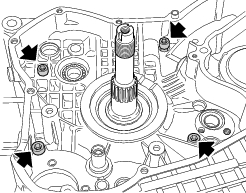
Fit four M8 screws into the holes shown in the figure and tighten to the specified torque (Sect. C 3, Engine torque settings).
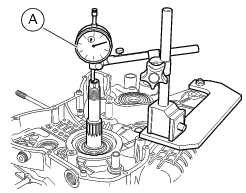
Place a dial gauge (A) with magnetic base on a support plate fixed to crankcase.
Bring stylus in contact with crankshaft end and set dial gauge to zero with the stylus touching the crankshaft.
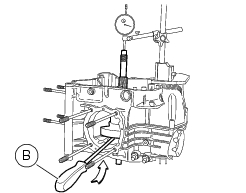
Place a lever (B) between casing and crank web and lever crankshaft pushing towards dial gauge.
Note dial gauge reading. This will be crankshaft end float. Add pre-load (0.30 mm) and total size of shims used (1.90x2=3.8 mm).
Divide by two and you have obtained the shimming required for each casing.
Note
After closing the casings, crankshaft must turn with some interference in the new bearings.
Shimming the gearbox shafts
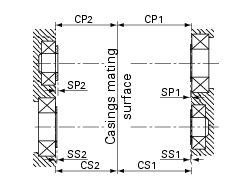
To establish the total shimming for the primary shaft "SP" and the secondary shaft "SS", proceed as follows.
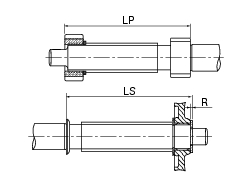
Measure “LP” and “LS” on the primary and secondary shafts (for secondary shaft, also add shim thickness “R” of 2.3 mm).
Measure the depth corresponding to the distance between the contact surface between the casings and the contact surface of the inner race of primary shaft bearing "CP1" and "CP2" and of the secondary shaft bearing "CS1" and "CS2".
Considering that end float should be 0.05 - 0.20 mm, and taking the average optimal value of 0.15 mm, this gives:
SP=CP1+CP2-LP-0.15 and
SS=CS1+CS2-LS-0.15.
To establish the size of each shimming, note that:
 
SP=SP1+SP2 and
SS=SS1+SS2
Where “SP1” and “SP2” represent the primary shaft shimming on the clutch side and chain side and “SS1” and “SS2” represent the corresponding secondary shaft shimming. This gives:
 
SP1=CP1-64-0.075 and
SS1=CS1-64-0.075 and therefore
SP2=SP-SP1 and SS2=SS-SS1.
Shimming the gearbox drum
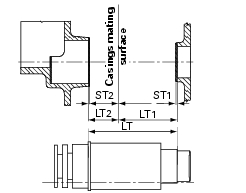
A similar procedure is used to establish the total shimming "ST" for the gearbox drum.
Given that:
LT1 = clutch-side casing depth
LT2 = chain-side casing depth
LT = gearbox drum shoulder
Considering that end float should be 0.10 - 0.40 mm
and taking the average optimal value of 0.25 mm,
we obtain: ST=LT1+LT2-LT-0.25.
Given that ST=ST1+ST2
hence ST1=LT1-59-0.125 and so
ST2=ST-ST1.
Practical shimming procedure for the selector drum and gearbox shafts
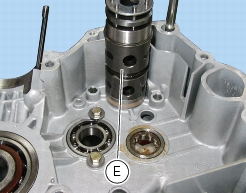
Following is a practical shimming procedure for gearbox selector drum (E), primary and secondary shaft.
Firstly, measure end float of the selector drum with no shims.
Separate the casings and remove the crankshaft with its shims (crankshaft has been shimmed previously).
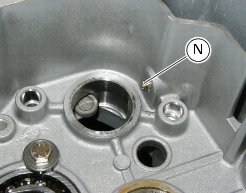
Extract the neutral switch (N) before fitting the selector drum into the casing to avoid damage to the switch.
Position the selector drum with no shims. Secure the casings by fitting a few screws in the holes near the drum position.
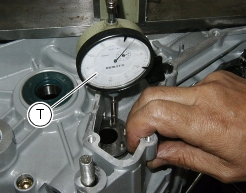
Place a dial gauge (T) with magnetic base on a support plate fixed to crankcase. Bring stylus in contact with selector drum end and set dial gauge to zero with the stylus touching the drum. Lever drum and note dial gauge reading. This will be total end float. Consider that the final end float should be between 0.10 and 0.40 mm, determine the amount of shimming required.
Divide total play by two to determine the amount of shimming required on each side of the selector drum.
Note
Final end float should be closer to 0.40 rather than 0.10 mm.
 
Separate the casings and insert the necessary shims on each side of the selector drum.
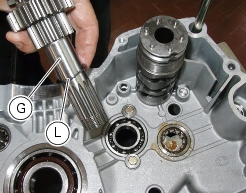
To shim the gearbox primary shaft (G), begin with a shim (L) of the same size used for the selector drum.
Fit the primary shaft to the clutch-side (right) casing with the shim.
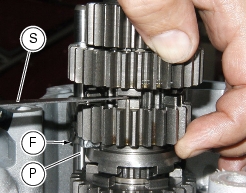
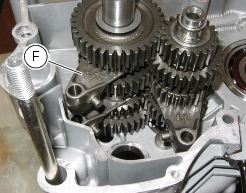
Install the fork (F) and its pin (P).
Check that the selector drum is in NEUTRAL, looking at the clutch-side end.
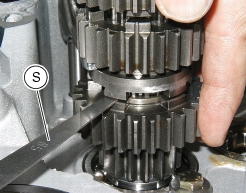
Now hold the primary shaft in position and check that the clutch dogs of the sliding gear are equally distant from the dogs of the fixed gears. This is done by inserting a feeler gauge (S) between the dogs.
Note
Press the sliding gear in both directions so as to take up play.
 
If the dogs are not equally distant from the other clutch dogs, change the primary shaft shim (L).
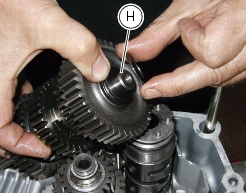
Fit a 2.5-mm shim (H) to the secondary shaft.
Fit the secondary shaft to the clutch-side (right) casing. Install the two forks with their pins.
Select a shim of adequate size following the same procedure as for the primary shaft.
Determine the amount of shimming for the left end (generator side) to obtain nearly zero end float when the casing is closed.
Place a small shim (1.5 mm) on primary shaft and no shims on the secondary shaft.
Remove selector drum, forks and pins.
Fit the casing and secure it with a few screws near the gearbox shafts.
Measure end float of secondary and primary shafts with the dial gauge.
Final play must be between 0.05 and 0.20 mm for both shafts.
Note
Play should be closer to 0.05 rather than 0.20 mm.
Checking gearbox position
After shimming the gearbox shafts, separate the casings.
Insert the forks (F) into the grooves of the sliding gears.
Install the selector drum with the calculated shims.
Position the forks to the drum and insert the pins.
Close the casings without the crankshaft to check gearbox position.
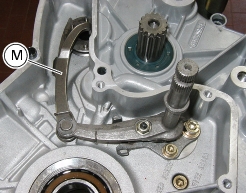
Install and adjust the gear selector lever assembly (M) (see Sect. N 7.1, Reassembling the gear selector lever).
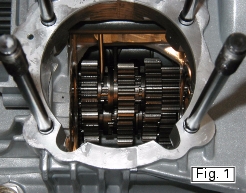
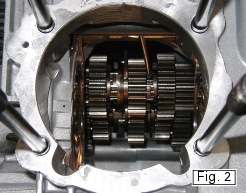
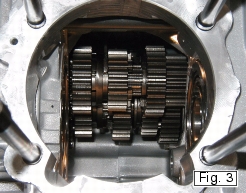
Place gearbox in NEUTRAL and look through the opening of the horizontal cylinder to check that the clutch dogs of the sliding gears are equally distant from the fixed gear dogs (Fig. 1 - Fig. 2).
Engage a gear and check that the fork is free in the sliding gear groove (Fig. 3).
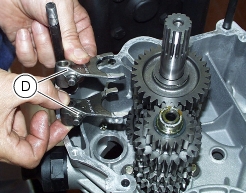
Insert the forks of the 1st-4th and 2nd-3rd gears (D) into the grooves of the secondary shaft driven gears.
Note
Both forks are alike.
 
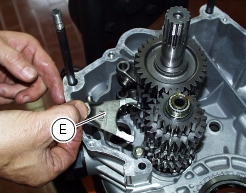
Insert the fork of the 5th-6th gears (E) into the primary shaft driven gear.
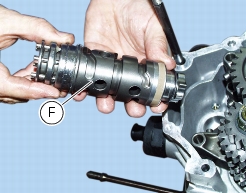
Fit the fork selector drum (F) in the casings with calculated shims.
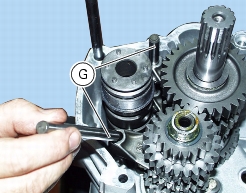
Fit the pins (G) in the forks you have just assembled.
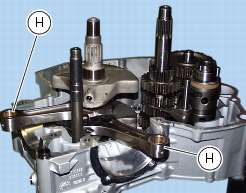
Fit the shimmed crankshaft into the clutch-side casing. Position the connecting rods (H) at their housings into cylinders.
Caution
Make sure that the connecting rods (H) are correctly positioned in the cylinders. Incorrect positioning will inevitably lead to reopening of the casing.
Make sure that the two centring bushes (22) are fitted.
Thoroughly grease the O-ring (31) and place it close to the oil duct connecting the two casings.
Closing the casings
Fit the timing layshaft (17) into the clutch-side casing roller bearing (4).
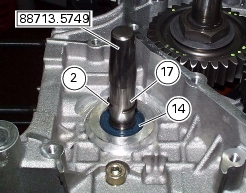
To prevent damage to the oil seal (14) on the timing layshaft, insert a protection cap part no. 88713.5749 on the shaft threaded end. Dampen the oil seal (14) with alcohol and fit it on the timing layshaft. Drive it fully home on the roller bearing (4).
Fit the circlip (2) into the shaft seat and remove the protection cap.
Note
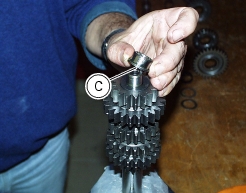
When refitting used components, make sure that the inner races (C) of the gearbox shaft end bearings are fitted into the correct bearing and are not on the shaft.
Match gearbox shafts, fit the previously calculated shims and fit them to the clutch-side casing.
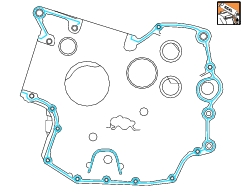
Apply a uniform bead of DUCATI sealing compound on the mating surface of the casing, avoiding the holes as shown in the figure.
Match the casings (3) and (13). Tap the area around the shafts with a plastic hammer, if necessary.
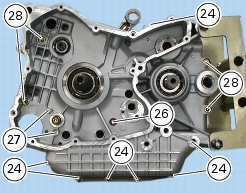
Grease the jointing screws with recommended grease and start them into their holes on the generator-side casing. The screws are not all the same length, be sure to position them correctly.
Progressively tighten the jointing screws all the way in. Begin with the larger diameter (M8) screws.
Fit two M8 screws (12) on the clutch side casing.
Tighten all screws to the specified torque (Sect. C 3, Engine torque settings). Begin with the larger diameter screws.
Check that crankshaft rotates with a certain amount of interference in the main bearings. Crankshaft must have a pre-load of 0.20-0.30 mm. Check also that all assembled parts can rotate or move correctly.
Fit the cartridge filter as described under Sect. D 4, Changing the engine oil and filter cartridge.
Fit oil seal (8) and spacer with O-ring on gearbox secondary shaft as described under Sect. G 8, Replacing the gearbox secondary shaft seal.
1