4.4 -
1
2
3
4
5
6
7
8
9
10
11
12
13
14
15
16
17
18
19
20
Spare parts catalogue
Caution
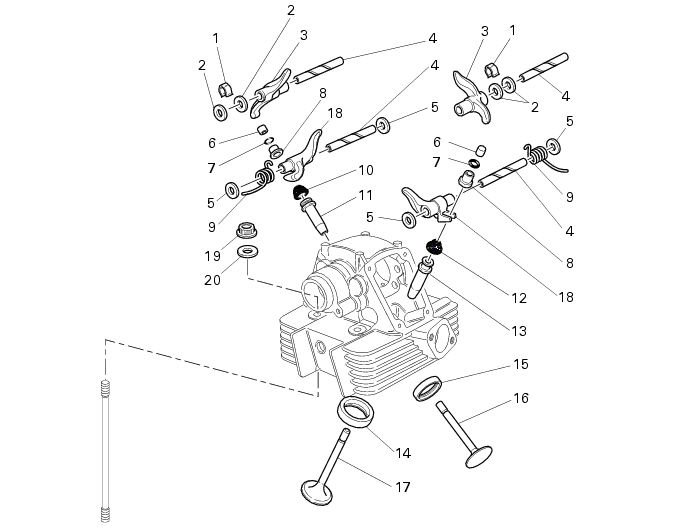
Bold reference numbers in this section identify parts shown in this exploded view diagram. These parts do not appear in the figures near the text.
Disassembling the engine heads
 
Note
For reasons of clarity, the figures show an engine block removed from the frame.
Removing the heads
Note
When disassembling the cylinder head, arrange the components in the correct order or mark their positions to refit them in the original position.
 
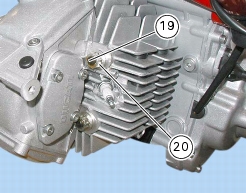
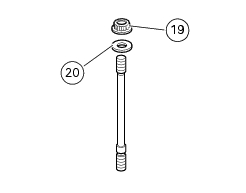
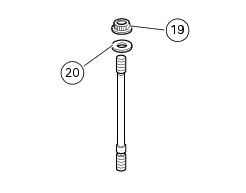
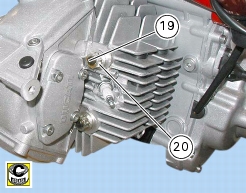
Using tool part no. 88713.2676 undo the nuts (19) on the head stud bolts.
Remove the nuts (19) and the special washers (20) positioned between nut and head.
Slide the complete head off the stud bolts and remove it from the engine block.
Removing the valves
 
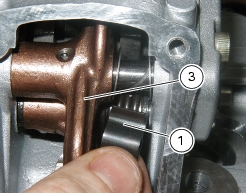
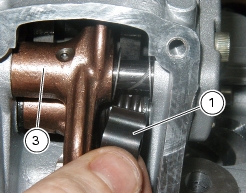
Slip off the clip (1) of the opening rocker arm (3).
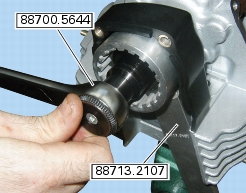
Fit tool part no. 88713.2107 to the head belt roller – or use the bush of tool part no. 88700.5644 – and rotate the camshaft so as to release the opening rocker arm (3).
Move the rocker arm (3) aside to release the valve opening shim (6).
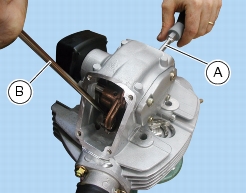
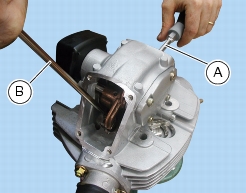
Using two screwdrivers, lock the closing rocker arm (18) with valve open: for position (A) set screwdriver under closing rocker arm, while for position (B) push onto closing rocker arm along valve axis.
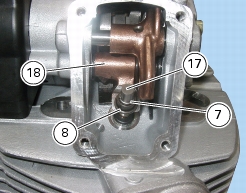
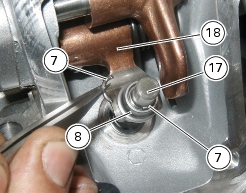
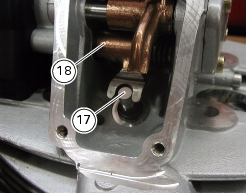
Slide the valve closing shim (8) along intake valve stem (17) to expose the two split rings (7) that retain the valve.
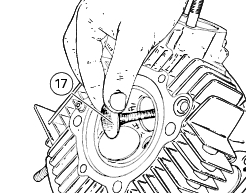
Remove the split rings (7) from valve stem using tweezers.
Remove the valve closing shim (8) from the valve (17).
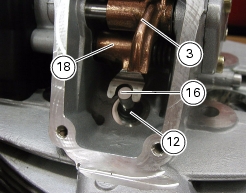
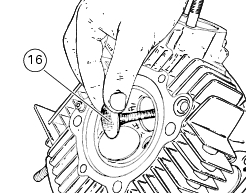
Withdraw the valve (17) from the bottom end of head.
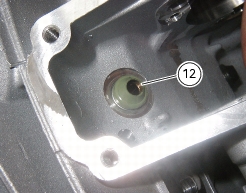
Remove the valve seal (12) from the head.
Repeat procedure to remove the exhaust valve (16).
Removing the valve rocker arms
 
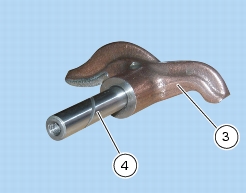
Remove the clip (1) from the rocker arm shaft (4).
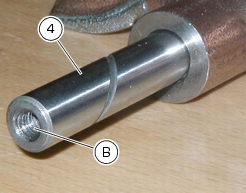
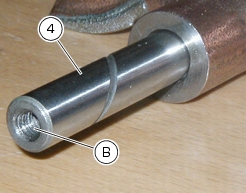
Screw the tool part no. 88713.1994, featuring M5 pin, on the thread of the opening rocker arm shaft (4).
Withdraw the rocker arm shaft (4).
Remove the opening rocker arm (3) with the two shims (2).
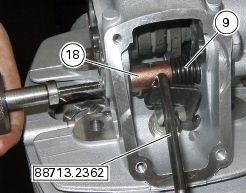
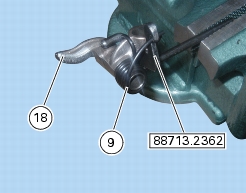
Hook the end of the spring (9) of the closing rocker arm (18) to tool part no. 88713.2362.
Remove the closing rocker arm shaft (4) using tool part no. 88713.1994. Collect the two shims (5).
Remove rocker arm (18), spring (9) and tool part no. 88713.2362.
Overhauling the head parts
Overhauling the heads
Remove the carbon deposits from the combustion chamber and relevant ducts.
Check that there are no cracks and that there are no grooves, steps or damage of any kind on the sealing surfaces.
Mating surface to cylinder must be perfectly flat.
Checking the valve
Check that the stem and the surface that contacts the valve seat are in good condition. There must be no pitting, cracks, deformations or signs of wear.
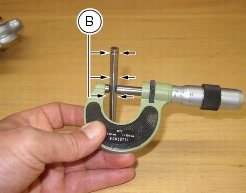
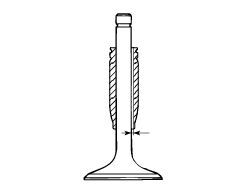
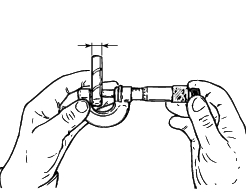
Check the following: measure the diameter of the stem (B) at various positions along the portion that runs in the valve guide.
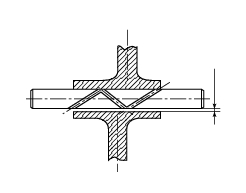
Check the valve stem for buckling. Place valve on a “V” block, set a dial gauge perpendicular to head and measure run-out of valve face slanted at 45°.
- Service limit: 0.03 mm
Checking the valve seat
Visually inspect valve seats: they must not show any signs of pitting or cracks.
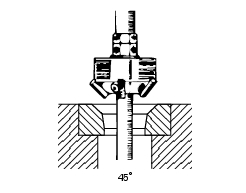
If the seat is slightly damaged, mill the seat, using suitable 45° cutters, then grind the valves and check valve sealing. If valve seat is excessively damaged, replace it choosing an adequately oversized valve seat. Spare valve seats are available with 0.03 and 0.06 mm outer diameter oversize.
Caution
If seats are replaced, change the valve guides as well.
Overhauling the valve guide
Check inner surface of valve guides for cracking or distortion. If exceedingly oval, hone mating surface with a bore reamer.
Note
Valve guide and valve must always be replaced as a set. Intake valves use cast-iron guides. Exhaust valves use bronze guides.
Checking valve - valve seat clearance
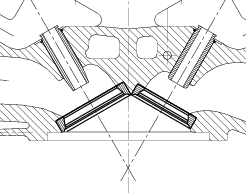
Use Prussian blue or a mixture of minium and oil to measure the contact surface (W) between valve and seat. Correct size is 1.0-1.5 mm.
 
Maximum limit:
2.0 mm.
Grind seat if outside the above limit.
 
Fill the intake and exhaust ducts with fuel to check for leaks. In the event of leakage, check the sealing surfaces for burrs.
Checking valve-valve guide clearance
Assembly clearance:
0.03-0.06 mm
 
Service limit:
0.08 mm.
Changing valve seats
Mill the worn seats to remove them. Ensure that you do not damage the valve seat location on the head.
Check the diameter of the housings in the head and choose an adequately oversized valve seat to obtain an interference fit to head of 0.11-0.16 mm. Spare valve seats are available with 0.03 and 0.06 mm outer diameter oversize.
 
Heat the cylinder head slowly and evenly up to 200 °C and cool the new seats in dry ice.
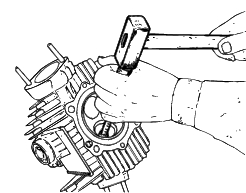
Drive the seats perfectly in square in their locations, using the suitable drift.
Let head cool down and then grind the valve seats, the jointing line of ducts and seat and grind the valves.
Changing valve guides
Change valve guides as follows.
Heat head gradually and evenly in an oven up to 200 °C.
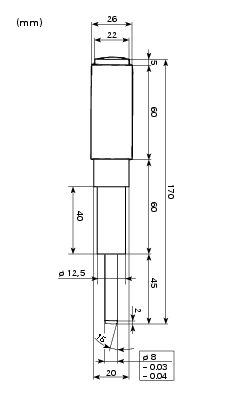
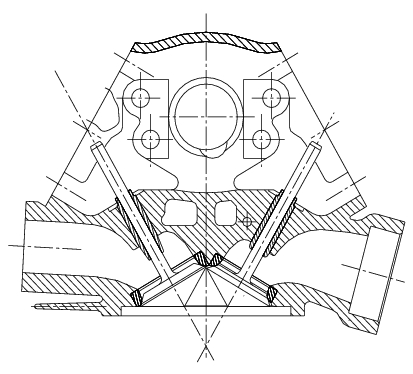
Remove original valve guides using a suitable tool (see diagram).
Let them cool down and check seat state and size.
Choose adequate valve guides to obtain an interference fit to head of 0.022-0.051 mm. Spare valve guides are available with 0.03, 0.06 and 0.09 mm outer diameter oversize and come complete with retaining ring.
Heat up head again and cool down the new valve guides in dry ice.
Lubricate seats in the head and install the valve guides. Push the retaining ring fully home into the head using the same drift as for removal.
Allow the head to cool down and hone inner bore.
Valve guide bore diameter:
8.00-8.022 mm.
Overhauling the rocker arms
Check that contact surfaces are in perfect condition. Check for signs of wear, grooves or pitting.
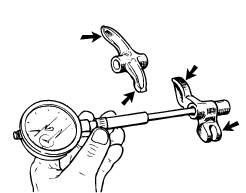
Check condition of rocker arm bore and shaft.
Nominal rocker arm bore diameter:
10.040-10.062 mm
Nominal rocker arm shaft diameter:
10.001-10.010 mm
Check that the contact surfaces of opening and closing shims are flat and show no signs of wear.
Rocker arm shaft-to-rocker clearance
Assembly clearance should be 0.03-0.06 mm.
Service limit:
0.08 mm.
Rocker arm shaft should be a tight fit in the head.
If it is loose, install the 0.02 mm oversized shaft available from the Spare Parts Department.
Checking the rocker arm springs
Check condition of closing rocker arm return springs. Check for cracking, distortion, or loss of spring.
 
Reassembling the head
Reverse the disassembly sequence. Pay particular attention to the operations described below.
It is very important to carefully clean all components.
 
Fit the oil seal (12) and (10) to the valve guide. Oil seals are colour-coded as follows:
- green seal for the exhaust valve
- black seal for the intake valve.
Lubricate the parts before installation.
Refitting the rocker arms
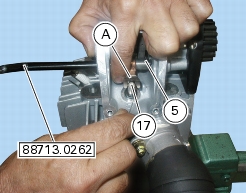
Fit the closing rocker arm (18) and its spring (9) to the tool part no. 88713.2362.
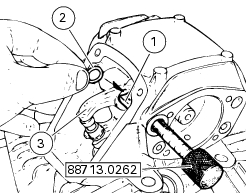
Insert the assembled tool-rocker arm-and-spring into the head and install the pin part no. 88713.0262 to hold assembly in place.
Install the valve (17) temporarily.
Fit as many shims (5) as required to centre the rocker arm fork (A) to valve stem.
Minimum operating clearance between valve stem and rocker arm:
0.15 mm.
 
Operating axial play of closing rocker arm:
0.05 0.20 mm.
 
Remove tool part no. 88713.0262 and insert the rocker arm shaft (4).
 
Caution
Install the rocker arm shafts (4) with the threaded hole end (B) pointing outwards.
Release the spring (9) and remove the tool part no. 88713.2362.
Using again pin part no. 88713.0262, set opening rocker arm (3) and fit side shims (2): position rocker arm and shims in the horizontal head exhaust side, in vertical head intake side, in horizontal head intake side and in vertical head exhaust side.
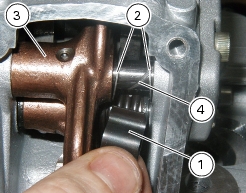
Place the shims (2) at both sides of the clip (1).
Axial play of opening rocker arm:
0.05 0.20 mm
 
After shimming, remove tool part no. 88713.0262 and position the shaft (4) with the threaded hole end (B) pointing outwards.
Insert side clip (1) onto pin (4) of opening rocker arm (3), in-between the two spacers (2).
 
Refitting the valves
Fit the valves (16) and (17) into the head.
Using two screwdrivers, lock the closing rocker arm (18) with valve open: for position (A) set screwdriver under closing rocker arm, while for position (B) push onto closing rocker arm along valve axis.
Locate the closing shim (8) to the valve stem (17) with the larger diameter facing the rocker arm.
Fit the split rings (7) to the valve stem.
Remove the two screwdrivers and place the closing rocker arm (18) in the rest position.
With the valve in the rest position, push on the rocker arm to counteract return spring action and check clearance between rocker arm sliding shoe and closing shim (Sect. N 4.1, Checking closing clearance (Sc) at exhaust/intake). If clearance is outside the specified limit, adjust valve clearance (Sect. N.4.1, Checking and adjusting valve clearance).
Fit the opening shim (6) to valve stem.
Position the opening rocker arm (3) and secure it with the clip (1). With the valve in the rest position, check clearance between rocker arm (3) and shim (6) (Sect. N 4.1, Checking opening clearance (Sa) at intake/exhaust).
If clearance is outside the specified limit, adjust valve clearance (Sect. N.4.1, Checking and adjusting valve clearance).
Repeat procedure for the exhaust valve (16).
Reassembling the heads
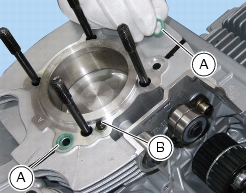
Make sure the O-rings (A) and the locating pin (B) are in place in the cylinder mating surface (Sect. N 5, Cylinder / piston assy) before installing the heads.
Caution
The locating pin (B) must be installed with the smallest hole pointing away from the cylinder (Sect. N 5, Cylinder / piston assy).
Slide the complete head on the stud bolts and push it down onto the cylinder.
Insert the special washers (20) on the stud bolts with the sharp edge facing the head and the flat side pointing inwards.
Grease the underhead of the nuts (19) and the thread of the stud bolts with the specified grease.
Fit tool part no. 88713.2676 to a torque wrench and tighten the nuts to the specified torque in a cross sequence (Sect. C 3, Engine torque settings).
Caution
Follow the above procedure closely. Improper tightening may cause the stud bolts to stretch abnormally leading to severe engine damage.